Trusted Voice Research Infrastructure for NGOs, Governments & Global Development Partners
Collection

Five routes in. One governed pipeline after that.

A channel is how an answer travels — a call, a message, a link, a field device. It is not the research design, and it is not a language capability: every route carries whatever the language layer can already do and adds nothing of its own. What each route changes is who you can reach, and what you have to give up to reach them.

The five collection routes

Each of these collects a response today. Consent is captured on the route itself, before the questions, on every one of them.

Phone call

Live

A respondent answers by speaking, on any phone, including one that cannot run an app.

What you should know

  • What can be done with the recording afterwards depends on the language. Recording speech and understanding it are two different capabilities, and the language pages state which applies where.
Who it reaches
People with no smartphone, no data, or no reading confidence — the group most often missing from a dataset.
How it works
The platform places or receives a call, asks the questions aloud, and records the answers. The recording is kept with the response.
Consent
Consent is captured in the call, before the questions.
WhatsApp

Live

A respondent answers by message or voice note, in the app they already use every day.

What you should know

  • WhatsApp carries whatever the language layer can already do. It is a route, not a language capability, and it adds no transcription or translation of its own.
  • Reaching a respondent first requires a number they have agreed can be contacted.
Who it reaches
Smartphone users across most African markets, at no airtime cost to the respondent.
How it works
An invitation opens a conversation. The respondent replies in text or sends a voice note; both arrive on the same session against the same questionnaire.
Consent
Consent is captured in the conversation, before the questions.

SMS

Live

A respondent answers by text message, with no app and no internet connection.

What you should know

  • Message length forces short questions and short answers. A long instrument is a poor fit for SMS and the platform does not pretend otherwise.
  • Text only. There is no voice on this route.
Who it reaches
Feature-phone users and anyone in a place with signal but no data.
How it works
Questions are sent as messages and answers come back as messages, with delivery receipts and retries where a message does not arrive.
Consent
Consent is captured by message, before the questions.

Web link

Live

A shareable link or QR code that opens the questionnaire in any browser.

What you should know

  • An open link has no sampling frame. Results describe the people who chose to answer, and the platform refuses to weight them as though they were a sample.
Who it reaches
Anyone you can reach with a link — email lists, printed posters, a partner’s website, a WhatsApp group.
How it works
One link serves the questionnaire in the languages the study has enabled. A respondent can stop and resume.
Consent
Consent is the first screen, before any question.

Offline field app

Live

A field worker collects with no connection at all, and the work syncs when a connection returns.

What you should know

  • Answers arrive after the fact rather than during a live conversation, so quality review happens on sync rather than in the moment.
  • The application is Android. There is no iOS build.
Who it reaches
Households, facilities and sites in places with no reliable network — which is most of where this work actually happens.
How it works
Assignments and questionnaires are downloaded to the device. Interviews, photographs, audio and location are captured offline into a queue, and the queue syncs when the device reconnects.
Consent
Consent is captured on the device, before the interview, and travels with the record.

Bringing in data you already hold

Held apart from the five routes above on purpose. A record that arrives through an import did not come from someone we spoke to, and it carries that origin rather than being mixed in as though it had.

API and import

Configured per deployment

Bring in data you already hold, or connect a system that produces it.

What you should know

  • This is data intake, not collection. A record that arrives this way did not come from a respondent VoiceInsights spoke to, and it carries that origin rather than being mixed in as though it had.
  • Each connection is configured for one deployment. There is no self-service connector catalogue.
How it works
Instruments can be imported rather than rebuilt, and an integration connection maps an external source onto the platform’s fields. Both are set up per deployment with your implementation team.

Routes we do not collect on

These get asked about, so they are answered here rather than left out. A designed interface is not a built one, and we do not present it as available.

Outbound only

Email

Outbound only. This is not a way to collect an answer.

Declared, not built

USSD

Stateless 182-char screens with a hard session timeout — the adapter must page long questions and cannot rely on the spine holding conversational state across screens.

Declared, not built

Telegram

Bot API updates are at-least-once; the adapter must dedupe on update_id.

Declared, not built

Signal

No hosted webhook exists; requires a self-hosted bridge outside the Worker runtime.

Declared, not built

Microsoft Teams

Tenant-scoped identity — the adapter must map an AAD object id to a respondent without treating it as PII in transit.

Declared, not built

Slack

Slack requires a 3-second ack; the adapter must ack before the spine runs and reply asynchronously.

The field app

Collect where there is no network at all

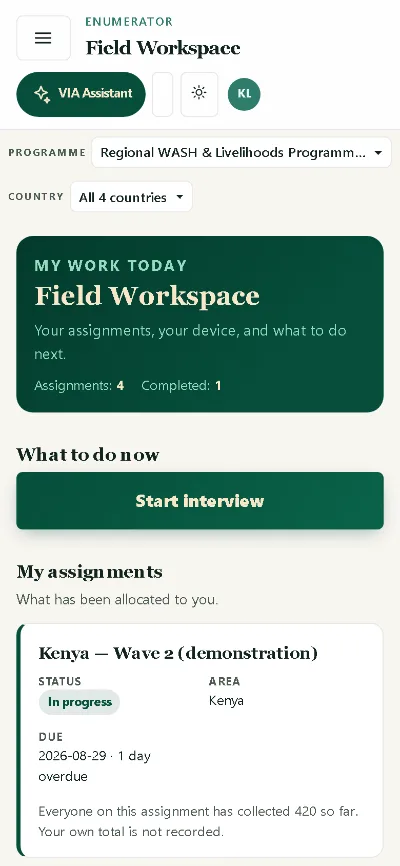
Assignments and questionnaires download to the device. Interviews, photographs, audio, location and consent are captured into a local queue with no connection, and the queue syncs when the device next reaches one. A field worker sees what is assigned to them, what is done and what is still pending — and nothing else.

The application is Android. There is no iOS build, and the Google Play listing is not published yet.

The Enumerator Field Workspace on a phone screen, showing today’s assignments and completion count, a "Start interview" action, and an assignment card for a demonstration wave in Kenya with its status, area and due date.
DEMONSTRATION · SYNTHETIC DATA Route: /app/enumerator-workspaceRole: EnumeratorOrganization: Great Lakes Health & Livelihoods Consortium (DEMONSTRATION)Countries: Kenya, Tanzania, Rwanda, UgandaViewport: 390x844Environment: previewCaptured: 2026-08-30

Choose the route with the people in mind

Who you need to hear from usually decides the channel before the study design does. Tell us who they are and where, and we will say which routes reach them.