Trusted Voice Research Infrastructure for NGOs, Governments & Global Development Partners
Multi-country programmes

One programme. Several countries. Still one institution.

A regional programme is not four deployments that happen to share a logo. It is one organization with a country structure inside it — and the hard part is not showing four countries on a dashboard, it is making sure the Tanzania team sees Tanzania while the regional director sees all four, without either of them becoming a separate tenant.

How the structure works

Programme, country and study are real objects with real relationships, not labels on a filter.

One organization, many countries

Live

A programme attaches to the countries it operates in. Projects attach to the programme by reference and never leave their own tenant, so adding a fifth country adds a country — it does not add an organization to administer, a user directory to duplicate or a second set of permissions to keep in step.

Country identity
A country deployment resolves through the canonical country-profile registry. An unrecognised country code is refused rather than accepted and quietly stored.
Reporting levels
Reporting is structurally supported at project, country and programme level — the same evidence rolled up, not three separate datasets kept in agreement by hand.

Country access is granted, not assumed

Live

An access grant names one person, one scope — organization, programme, country, study or campaign — one stated purpose, and an expiry. Someone with no grant keeps exactly what their role already gives them; someone with grants is confined to the union of those grants.

What you should know

  • A grant can only narrow. It can never widen what a role allows, and it can never reach past the organization it was written in — so a badly written grant cannot become a privilege escalation.
  • Every grant carries a stated purpose. A grant nobody can justify at review is a grant that should not have been written, and the field is required for that reason.
Revocation
Revocable by the granting organization alone, with the reason recorded. Revocation takes effect immediately.
Recorded, not implied
An explicit organization-wide grant can be written down. “Nobody restricted this person” and “someone decided this person is organization-wide” are different facts, and an auditor asks for the second.

Partners get a grant, not a seat

Live

Consortium membership confers no data access at all. Access exists only as an explicit grant naming one scope, one permission list, one purpose and one expiry — approved through the governance workflow by a separate person with decision authority.

Leaving a consortium
Revokes every grant that flowed from it, immediately.
What can never be granted
No tenant-administration permission can be granted to another organization, under any arrangement.
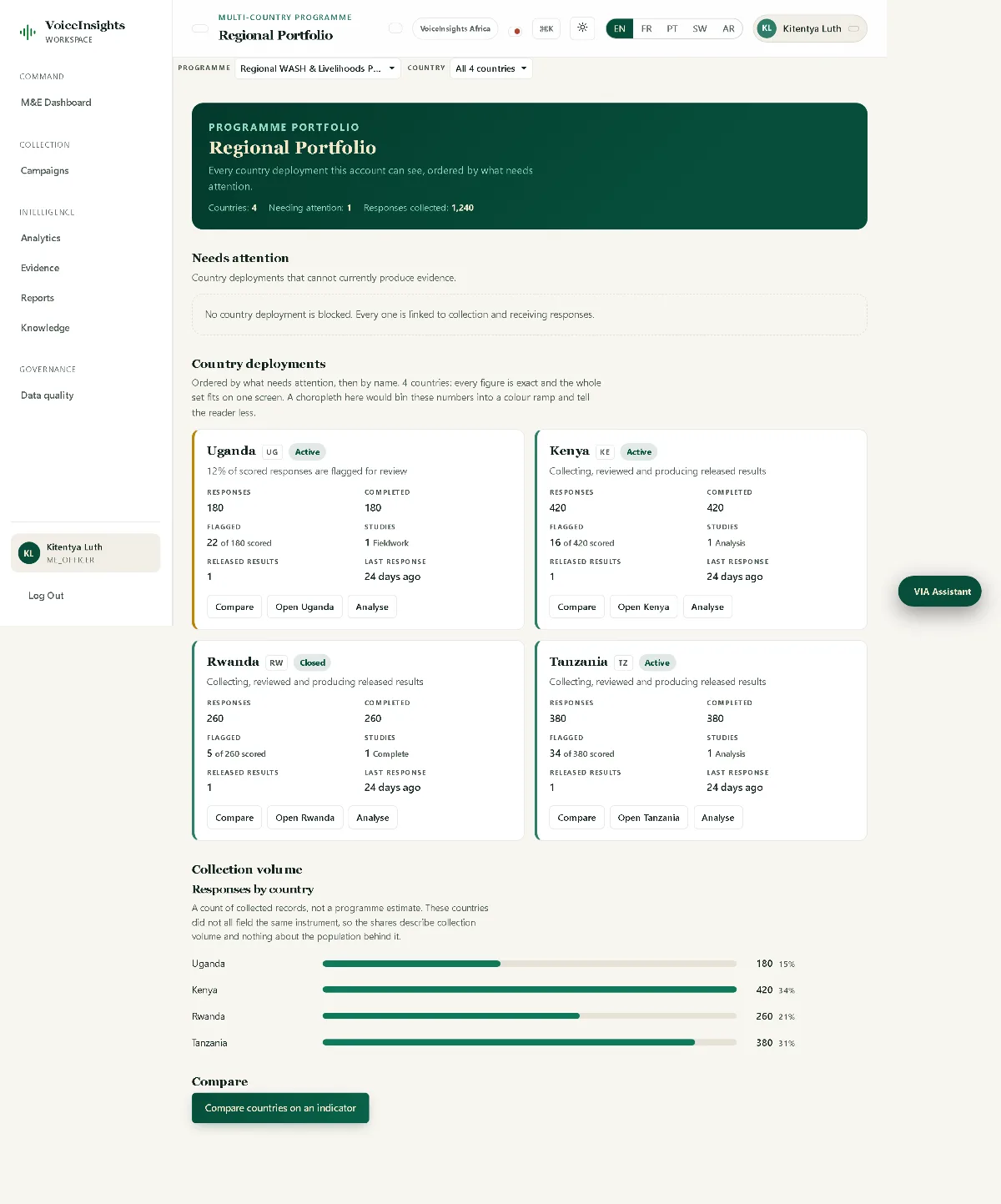
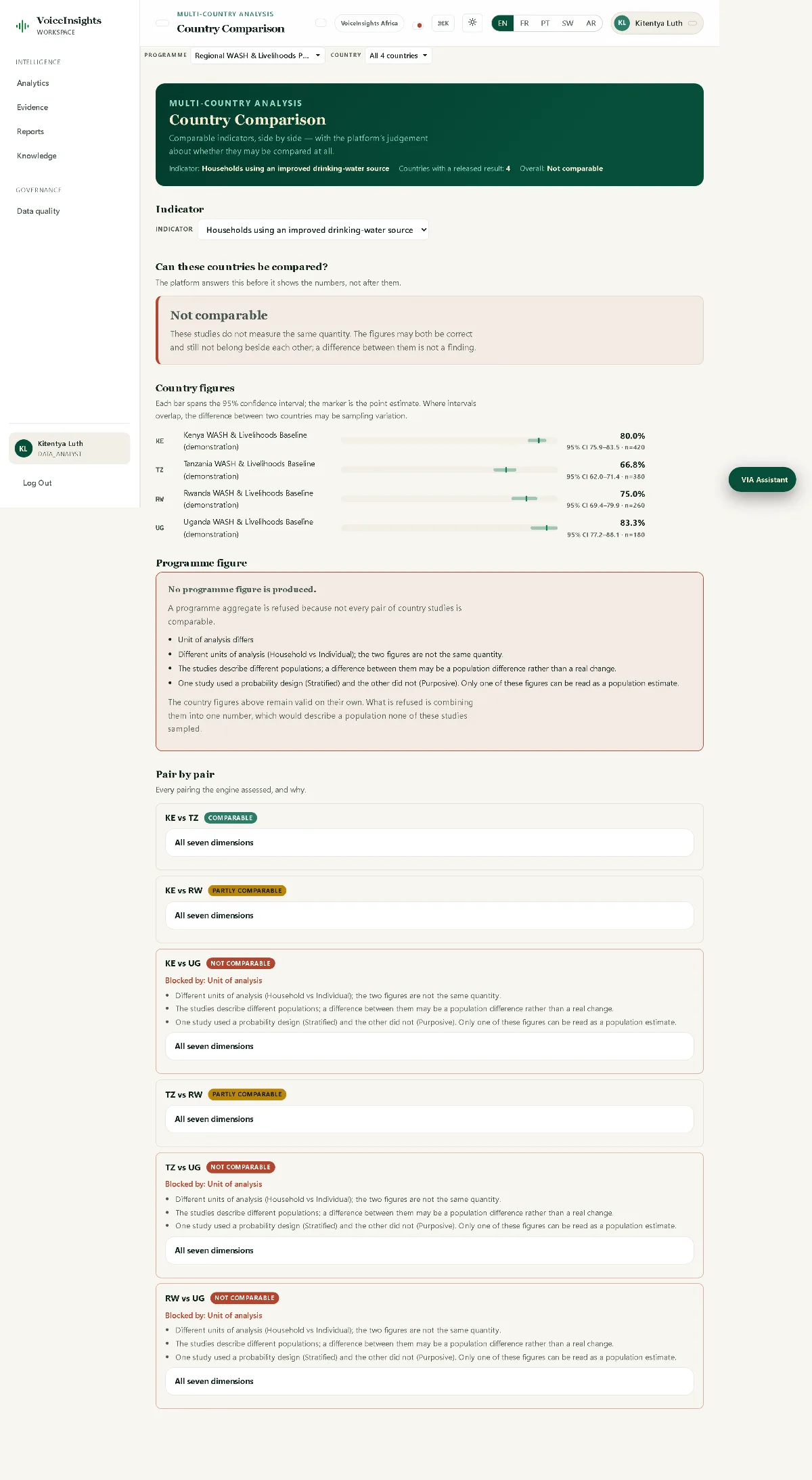
What a regional team actually sees

These are captures of the deployed product on a demonstration tenant. Every figure in them was counted from governed records — none of it is illustration, and none of it describes a real programme.

The Regional Portfolio at desktop width, showing four country deployments side by side with per-country response, completion, quality-flag and study figures.
DEMONSTRATION · SYNTHETIC DATA Route: /app/regional-portfolioRole: M&E OfficerOrganization: Great Lakes Health & Livelihoods Consortium (DEMONSTRATION)Countries: Kenya, Tanzania, Rwanda, UgandaViewport: 1440x900Environment: previewCaptured: 2026-08-30
The Country Comparison workspace, comparing indicator results across country deployments in a demonstration multi-country programme.
DEMONSTRATION · SYNTHETIC DATA Route: /app/country-comparisonRole: Data AnalystOrganization: Great Lakes Health & Livelihoods Consortium (DEMONSTRATION)Countries: Kenya, Tanzania, Rwanda, UgandaViewport: 1440x900Environment: previewCaptured: 2026-08-30

Countries differ, and the comparison has to survive that

Deployments are not uniform. One country runs mostly on WhatsApp and another mostly on SMS; one study is complete while another is still in the field; quality profiles differ by team and by terrain. A comparison surface that only works when every country looks the same is a comparison surface that has never met a programme.

Comparability is assessed, not assumed

Live

Before two countries are compared, the platform records whether they are actually comparable — same instrument, same question wording, same unit of analysis, same period. Where they are not, the assessment says so rather than producing a chart that quietly compares two different questions.

Evidence stays attached
A figure in a regional roll-up traces back to the study, the responses and the country it came from. A number that cannot be traced is not published as evidence.
Language follows the country
Each country collects in its own languages. What can be done with those languages afterwards differs, and the capability is recorded per language rather than assumed from the programme.

Two questions we answer carefully

Both come up in every multi-country procurement, and both have answers that are easy to overstate.

Stated precisely

  • Data residency. Jurisdiction controls are available in the underlying infrastructure and are not currently configured, and the platform cannot read the resulting placement. We will not tell you data “stays in” a named country, because we cannot verify it.
  • Location. Coordinates are stored as reported by the collecting device, with that device’s own accuracy value alongside. Nothing verifies that a point is where it says it is, so we quote no positional accuracy figure.

Bring us your country structure

Tell us the countries, the teams and who is allowed to see what. We will show you the same structure in the product rather than describing it.