Analysis and interpretation
You turn a reviewed dataset into results that will survive being challenged. The platform is opinionated about what it will and will not compute, and knowing where those lines are is most of doing this job well here.
What you are responsible for
The analysis and its stated method. You are not responsible for approving publication, and you are responsible for refusing to produce a figure the design cannot support — the platform will refuse with you.
The analysis workspace
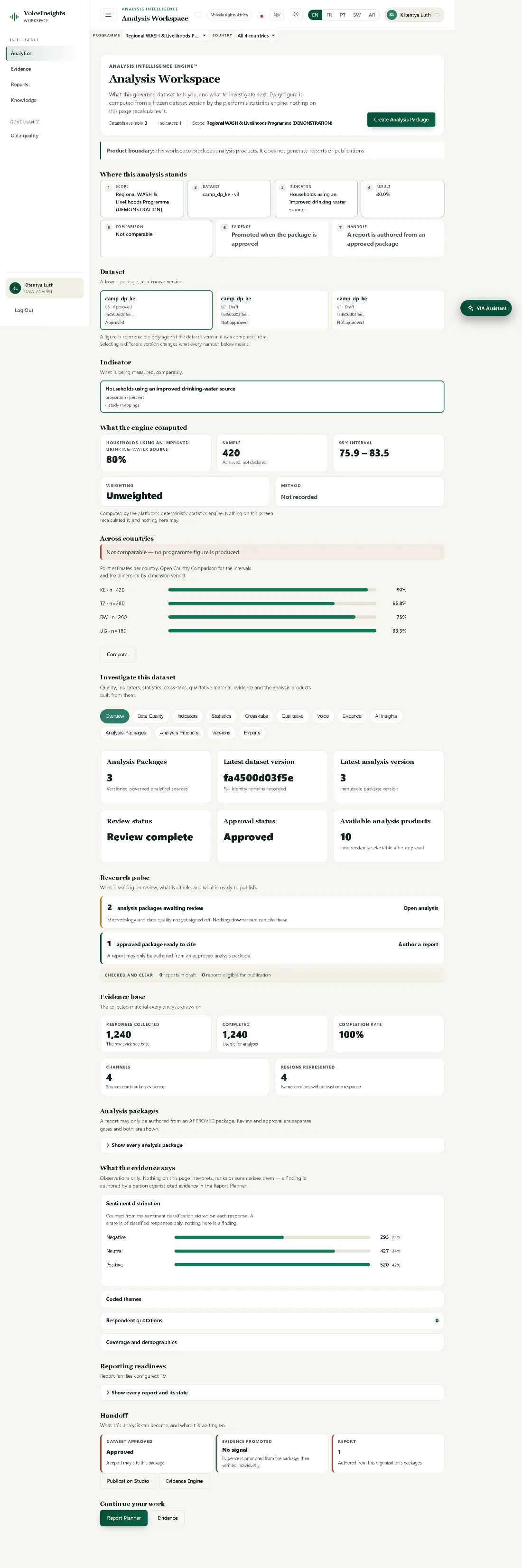
An analysis runs against a dataset snapshot rather than against live rows, so a result can be reproduced later. Every run carries its method, its n, its weighting state and its interval.
What the platform will compute
- Descriptives, proportions and means, with Wilson intervals for proportions and Welch–Satterthwaite for means.
- Significance tests, disaggregation and cross-tabs where the design supports them.
- Weighted and unweighted estimates, with the weighting state stated on every figure.
What it will refuse, and why that is the feature
- A non-probability sample is refused representativeness, regardless of what the study declares and however large it is.
- Such a design cannot be post-stratified. Weights that imply a sampling frame which never existed are refused rather than produced.
- A figure cannot be quoted without its method and weighting state — the four travel together.
- An undeclared methodology field reports NOT_PROVIDED rather than being omitted, so the gap is visible instead of invisible.
Connecting results to evidence
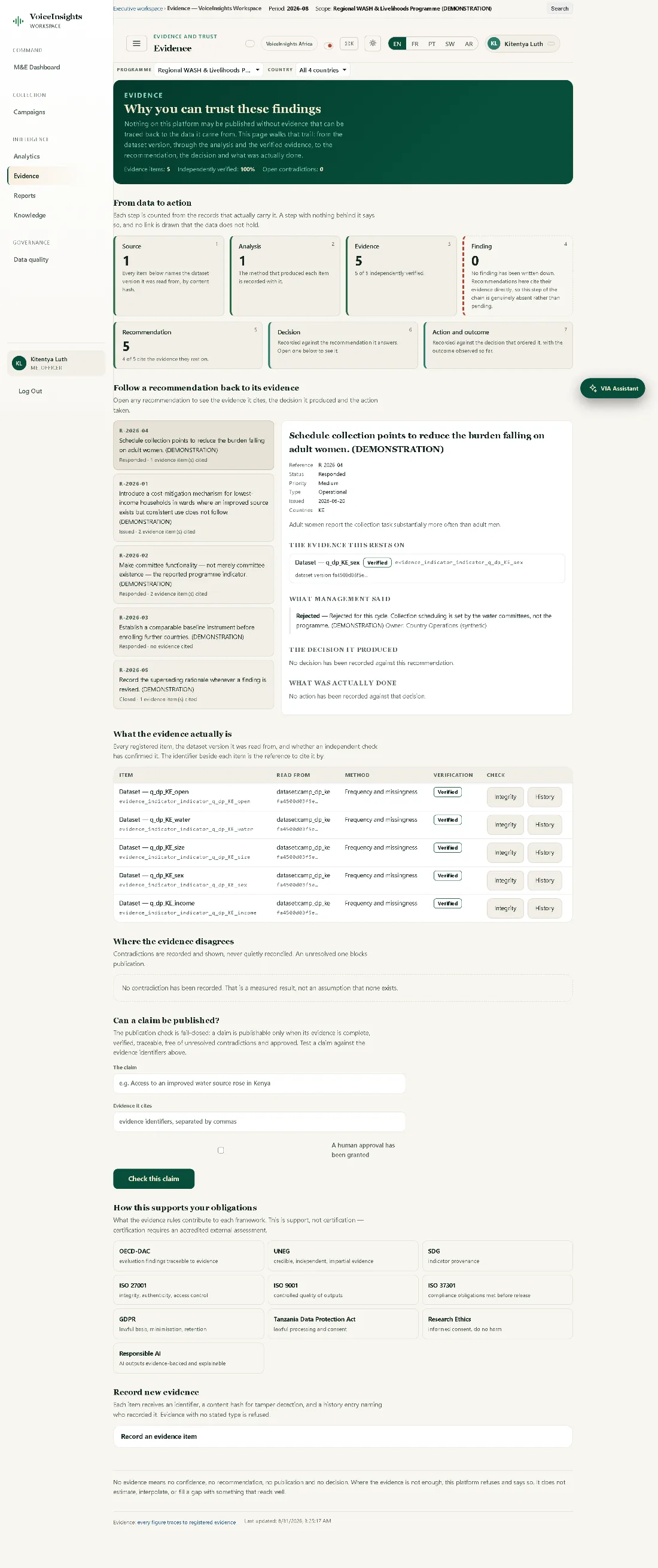
An analysis result becomes usable when it is linked to the evidence it rests on. That link is what lets a reviewer follow a claim in a report back to the responses behind it.
Getting results out
Datasets and results export in the formats a team already works in. DOCX, PPTX and XLSX were compared inside the decompressed documents and carry identical facts. PDF renders as a valid document; its content was not machine-verified, and we do not claim it was.
When something goes wrong
| What you see | What to do |
|---|---|
| An analysis will not run | Check the study’s declared design. A mismatch between design and requested analysis is refused at validation with the reason. |
| Weights are refused | The design is non-probability. This is the refusal working, not a configuration problem. |
| A figure looks wrong against the field’s own count | Check the snapshot date. An analysis runs against a snapshot; live collection has moved on since. |
| An export is refused | Something the output claims does not resolve to an evidence record. The refusal names it. |
Limits worth knowing before you plan around them
What this role cannot do, and what the platform does not offer
- There is no automated triangulation or joint-display engine for mixed-methods work. Bringing a quantitative and a qualitative strand into one narrative is your work, supported by the platform rather than performed by it.
- The platform does not detect the language of a response. A declared language is what the caller supplied.
- No speech-recognition accuracy figure exists for any African language, because none has been benchmarked. Do not quote one.